
 |
Like all other cultural facets of Rajasthan, music and dances of Rajasthan are also very rich. Let's have a look at various folk dances and music of Rajasthan.
|
Music & Dances of Rajasthan
In the realm of the folkways dance and music rule supreme and one cannot think of Rajasthan without this important element of its folk life. A large variety of musical instruments is used in the countryside. It ranges from the soft tinklers to thunderous kettledrums; from simple, slender flutes to intriguing trumpets; and from the rustic looking resonators for basic rhythm to elegant and fully developed bowing or plucking devices.
It is a fascinating sight to see the folk musicians of Rajasthan with their musical instruments, who besides dressing themselves in colorful attire, also decorate and embellish their instruments with beautiful trappings and ornamental coverings. They are a people with music in their souls. Their amazingly rich music has an extraordinary individuality, tradition and exotic flavor, which gives a distinctive feature and quality to their musical sounds, and a certain pulse which does not fail to fascinate the listener, staying like lingering perfume. They have songs for every occasion with rich emotional content, almost an endless variety of tunes, quite a few delightful dance forms, and a large number of musical instruments, all a collective creation of the folks which is retained by them in its traditional form and character and passed from one generation to the other.
The people of Rajasthan live life to the hilt. After hard work in the harsh desert sun and the rocky terrain whenever they take time off they let themselves go in gay abandon. There is dancing, singing, drama, devotional music and puppet shows and other community festivities which transform the hardworking Rajasthani into a fun-loving and carefree individual. Each region has its own folk entertainment, the dance styles differ as do the songs. Interestingly enough, even the musical instruments are different.
Of considerable significance are the devotional songs and the communities who render these songs. Professional performers like the Bhaats, Dholis, Mirasis, Nats, Bhopas and Bhands are omnipresent across the state. They are patronised by the villagers who participate actively in the shows put up by these travelling entertainers. Some of the better known forms of entertainment are:
Ghoomar Dance: This is basically a community dance for women and performed on auspicious occasions. Derived from the word ghoomna, piroutte, this is a very simple dance where the ladies move gently, gracefully in circles.
Gait Ghoomar: This is one of the many dance-forms of the Bhil tribals. Performed during Holi festival, this is among a few performances where both men and women dance together.
Gait: Another Holi dance but performed only by men. This becomes Dandia Gair in Jodhpur and Geendad in Shekhawati.
Chart Dance: This is popular in the Kishengarh region and involves dancing with a chari, or pot, on one's head. A lighted lamp is then placed on the pot.
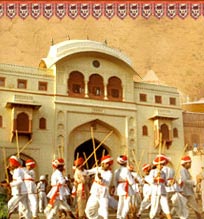
Kachhi Ghodi: This is a dance performed on dummy horses. Men in elaborate costumes ride the equally well decorated dummy horses. Holding naked swords, these dancers move rhythmically to the beating of drums and fifes. A singer narrates the exploits of the Bavaria bandits of Shekhawati.
Fire Dance: The Jasnathis of Bikaner and Chum are renowned for their tantric powers and this dance is in keeping with their lifestyle. A large ground is prepared with live wood and charcoal where the Jasnathi men and boys jump on to the fire to the accompaniment of drum beats. The music gradually rises in tempo and reaches a crescendo; the dancers seem to be in a trance like state.
Drum Dance: This is a professional dance-form from Jalore. Five men with huge drums round their necks, some with huge cymbals accompany a dancer who holds a naked sword in his mouth and performs vigorously by twirling three painted sticks.
Teerah Taali: The Kamad community of Pokhran and Deedwana perform this dance in honor of theft deity, Baba Ramdeo. Rather unusual performances, where the men play a four-stringed instrument called a chau-tara and the women sit with dozens of manjeeras, or cymbals, tied on all over their bodies and strike them with the ones they hold in their hands. Sometimes, the women also hold a sword between their teeth or place pots with lighted lamps on their heads.
Kathputli: Puppet plays based on popular legends are performed by skilled puppeteers. Displaying his skill in making the puppets' act and dance, the puppeteer is accompanied by a woman, usually his wife, who plays the dholak, or drum and sings the ballad.
Pabuji Ki Phach: A 14th century folk hero, Pabuji is revered by the Bhopa community. The phad, or scroll, which is about 10 metres long, highlights the life and heroic deed of Pabuji. The Bhopas are invited by villagers to perform in their areas during times of sickness and misfortune. The ballad is sung by the Bhopa as he plays the Ravan-hattha and he is joined by his wife who holds a lamp and illuminates the relevant portions at appropriate points.
Maand: Rajasthan's most sophisticated style of folk music and has come a long way from the time it was only sung in royal courts, in praise of the Rajput rulers.
Professional singers still sing the haunting ballads of Moomal Mahendra, Dhola-Maru and other legendary lovers and heroes.
List of singers and performers also includes the Mirasis and Jogis of Mewat, Manganiyars and Langas, Kanjars, Banjaras and Dholies. Performances like the Kuchamani Khayal, Maach, Tamasha, Rammat, Nautanki and Raasleela are no less popular. The musical instruments of Rajasthan are simple but quite unusual. Handcrafted by the musicians themselves they are rather unique and include instruments like the Morchang, Naad, Sarangi, Kamayacha, Rawanhattha, Algoza, Khartal, Poongi, Bankia and Da There are dozens of other instruments which are exclusive to Rajasthan only.
It is a fascinating sight to see the folk musicians of Rajasthan with their musical instruments, who besides dressing themselves in colorful attire, also decorate and embellish their instruments with beautiful trappings and ornamental coverings. They are a people with music in their souls. Their amazingly rich music has an extraordinary individuality, tradition and exotic flavor, which gives a distinctive feature and quality to their musical sounds, and a certain pulse which does not fail to fascinate the listener, staying like lingering perfume. They have songs for every occasion with rich emotional content, almost an endless variety of tunes, quite a few delightful dance forms, and a large number of musical instruments, all a collective creation of the folks which is retained by them in its traditional form and character and passed from one generation to the other.
The people of Rajasthan live life to the hilt. After hard work in the harsh desert sun and the rocky terrain whenever they take time off they let themselves go in gay abandon. There is dancing, singing, drama, devotional music and puppet shows and other community festivities which transform the hardworking Rajasthani into a fun-loving and carefree individual. Each region has its own folk entertainment, the dance styles differ as do the songs. Interestingly enough, even the musical instruments are different.
Of considerable significance are the devotional songs and the communities who render these songs. Professional performers like the Bhaats, Dholis, Mirasis, Nats, Bhopas and Bhands are omnipresent across the state. They are patronised by the villagers who participate actively in the shows put up by these travelling entertainers. Some of the better known forms of entertainment are:
Ghoomar Dance: This is basically a community dance for women and performed on auspicious occasions. Derived from the word ghoomna, piroutte, this is a very simple dance where the ladies move gently, gracefully in circles.
Gait Ghoomar: This is one of the many dance-forms of the Bhil tribals. Performed during Holi festival, this is among a few performances where both men and women dance together.
Gait: Another Holi dance but performed only by men. This becomes Dandia Gair in Jodhpur and Geendad in Shekhawati.
Chart Dance: This is popular in the Kishengarh region and involves dancing with a chari, or pot, on one's head. A lighted lamp is then placed on the pot.
Kachhi Ghodi: This is a dance performed on dummy horses. Men in elaborate costumes ride the equally well decorated dummy horses. Holding naked swords, these dancers move rhythmically to the beating of drums and fifes. A singer narrates the exploits of the Bavaria bandits of Shekhawati.
Fire Dance: The Jasnathis of Bikaner and Chum are renowned for their tantric powers and this dance is in keeping with their lifestyle. A large ground is prepared with live wood and charcoal where the Jasnathi men and boys jump on to the fire to the accompaniment of drum beats. The music gradually rises in tempo and reaches a crescendo; the dancers seem to be in a trance like state.
Drum Dance: This is a professional dance-form from Jalore. Five men with huge drums round their necks, some with huge cymbals accompany a dancer who holds a naked sword in his mouth and performs vigorously by twirling three painted sticks.
Teerah Taali: The Kamad community of Pokhran and Deedwana perform this dance in honor of theft deity, Baba Ramdeo. Rather unusual performances, where the men play a four-stringed instrument called a chau-tara and the women sit with dozens of manjeeras, or cymbals, tied on all over their bodies and strike them with the ones they hold in their hands. Sometimes, the women also hold a sword between their teeth or place pots with lighted lamps on their heads.
Kathputli: Puppet plays based on popular legends are performed by skilled puppeteers. Displaying his skill in making the puppets' act and dance, the puppeteer is accompanied by a woman, usually his wife, who plays the dholak, or drum and sings the ballad.
Pabuji Ki Phach: A 14th century folk hero, Pabuji is revered by the Bhopa community. The phad, or scroll, which is about 10 metres long, highlights the life and heroic deed of Pabuji. The Bhopas are invited by villagers to perform in their areas during times of sickness and misfortune. The ballad is sung by the Bhopa as he plays the Ravan-hattha and he is joined by his wife who holds a lamp and illuminates the relevant portions at appropriate points.
Maand: Rajasthan's most sophisticated style of folk music and has come a long way from the time it was only sung in royal courts, in praise of the Rajput rulers.
Professional singers still sing the haunting ballads of Moomal Mahendra, Dhola-Maru and other legendary lovers and heroes.
List of singers and performers also includes the Mirasis and Jogis of Mewat, Manganiyars and Langas, Kanjars, Banjaras and Dholies. Performances like the Kuchamani Khayal, Maach, Tamasha, Rammat, Nautanki and Raasleela are no less popular. The musical instruments of Rajasthan are simple but quite unusual. Handcrafted by the musicians themselves they are rather unique and include instruments like the Morchang, Naad, Sarangi, Kamayacha, Rawanhattha, Algoza, Khartal, Poongi, Bankia and Da There are dozens of other instruments which are exclusive to Rajasthan only.

