
 |
Read about the culture and arts and crafts of Rajasthan, one of the most colorful states in India.
|
Rajasthan Culture
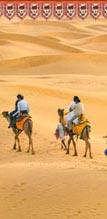
Rajasthan, the land of royalty, is a glittering jewel set in the golden sands of a barren deserts landscape. The light that reflects off the golden sands engulfs a land renowned for its vibrant colors, people in bright clothes and beautiful jewelry, living in cities dotted and dominated by towering forts and palace that rise from the sands like mirage.
The brightness of its life, the legends of its heroism and romance are all captured in the vibrant and evocative music of this desert land. There is a richness and diversity in Rajasthani music which comes from a tradition that is old and undisturbed, and from a culture that has imbibed the best from its neighboring states of Sindh, Gujurat, Malwa, Mewar, Haryana and Punjab.
Music which rich evocative heroic plaintive and joyful governs all aspects of Rajasthani lives. The voices both male and female are strong and powerful. The numerous songs sang by the women reflect the various feminine moods and strong family ties that govern their lives, Peepli and Nihalde are songs imploring the beloved not to leave her or to return to her as soon as he can.
There are songs about the family comparing every member to the numerous ornaments worn by women. The festivals of gangaur and teej, celebrating marital bliss and the brief but splendid moonsoon of Rajasthan call for special songs without which no celebration is complete.
Men and women of Rajasthan sing devotional as well as festive songs. Songs by the saint-poets like Kabir, Meera and Malookdas are part of the folk repertoire. They are sung all night during the raatjagas (all night soirees spent singing devotional songs) which are held as thanks giving to a particular deity. The resonant singing of the Rajasthani folk is accompanied by music from simple instruments like the Baara and Algoza, which usally give a beat or a drone to offset the poetry.
Fairs and festivals bring an even greater riot of color and music into lives of the desert people. Holi, the festival of colors, brings forth the joyous, lively rhythms of the change and dhamal songs Marriage, childbirth the visit of the son-in-law, all call for song and music. Even children have their own special songs called the saanjhi and the Ghulda. Favorites that are sung at all times are the Panihari Eendoni, the famous Kurjan Digipuri-ka-raja and the Rasiya songs of the Braj region.
The tough life of the desert dwellers made them seek means of making life more pleasant by developing their artistic talents. There are many traditional communities who are professional performers and their skills are handed down from generation to generation. The Bhat and Charans are bards, who could inspire the Rajput warriors with accounts of heroic deeds by whipping up patriotic flavor or even ridiculing the royal families with their satire.
The wandering balladeers, like the Bhopas who sing about the Marwar folk hero-Pabuji, travel from village with their phad painting and rawan hahha entertaining people with their ballad. There are many singing communities in Rajasthan known as the Dholis. Dholis are also known by other names like Mirasis, Dhadhis, Langas, Manganiyars, Kalbelias, Jogis, Sargaras, Kamads, Nayaks or Thotis and the Bawaris.
The brightness of its life, the legends of its heroism and romance are all captured in the vibrant and evocative music of this desert land. There is a richness and diversity in Rajasthani music which comes from a tradition that is old and undisturbed, and from a culture that has imbibed the best from its neighboring states of Sindh, Gujurat, Malwa, Mewar, Haryana and Punjab.
Music which rich evocative heroic plaintive and joyful governs all aspects of Rajasthani lives. The voices both male and female are strong and powerful. The numerous songs sang by the women reflect the various feminine moods and strong family ties that govern their lives, Peepli and Nihalde are songs imploring the beloved not to leave her or to return to her as soon as he can.
There are songs about the family comparing every member to the numerous ornaments worn by women. The festivals of gangaur and teej, celebrating marital bliss and the brief but splendid moonsoon of Rajasthan call for special songs without which no celebration is complete.
Men and women of Rajasthan sing devotional as well as festive songs. Songs by the saint-poets like Kabir, Meera and Malookdas are part of the folk repertoire. They are sung all night during the raatjagas (all night soirees spent singing devotional songs) which are held as thanks giving to a particular deity. The resonant singing of the Rajasthani folk is accompanied by music from simple instruments like the Baara and Algoza, which usally give a beat or a drone to offset the poetry.
Fairs and festivals bring an even greater riot of color and music into lives of the desert people. Holi, the festival of colors, brings forth the joyous, lively rhythms of the change and dhamal songs Marriage, childbirth the visit of the son-in-law, all call for song and music. Even children have their own special songs called the saanjhi and the Ghulda. Favorites that are sung at all times are the Panihari Eendoni, the famous Kurjan Digipuri-ka-raja and the Rasiya songs of the Braj region.
The tough life of the desert dwellers made them seek means of making life more pleasant by developing their artistic talents. There are many traditional communities who are professional performers and their skills are handed down from generation to generation. The Bhat and Charans are bards, who could inspire the Rajput warriors with accounts of heroic deeds by whipping up patriotic flavor or even ridiculing the royal families with their satire.
The wandering balladeers, like the Bhopas who sing about the Marwar folk hero-Pabuji, travel from village with their phad painting and rawan hahha entertaining people with their ballad. There are many singing communities in Rajasthan known as the Dholis. Dholis are also known by other names like Mirasis, Dhadhis, Langas, Manganiyars, Kalbelias, Jogis, Sargaras, Kamads, Nayaks or Thotis and the Bawaris.

